Sunday, May 11, 2014

German islands and drinking water - the final presentation of class 7c

Sometimes it happens that students are missing unfortunately at school on the day you scheduled the presentation. But they had done a lot of hard work of research, collecting pictures, translating phrases into English, etc. It was their primar wish to get a second chance to present "their" island to an international audience. Three students' groups introduced the German islands Sylt, Norderney and Pellworm to an international audience.


Despite of the main presentation there were not adult guests only. Some classes were joing the presentation as well. Because Skype has closed their free access to group conversations we used google hangout to gather all groups into one meeting.

Grade 7 students from Rock Academy School in Fish Hoek, Cape Town, South Africa, and their teacher, Mrs Beal, Grade 4 kids from Kiohsiung, Taiwan, and their teacher Mrs Tan at the Public Primary School as well as Mrs Mirtschin from Hawkesdale College in Hawkesdale, Victoria, Australia, listened to the kids and watched the slides on the screenshared board.


The whole session took about 30 minutes time. Thanks to all guests and we hope to do our next presentation very soon.

Mrs Tan prepares a little slideshow with the pictures she has taken from this meeting.

Thank you very much to all our guests for their kind support.

Thursday, May 1, 2014

A Close encounter of the Third Kind

A "close encounter to the Third Kind", that could be the impressions people might have received during the first meeting of my grade 8 kids this morning with students of the same age from the "Born To Excel - Success Motivation Center", Muttar, District of Kerala, India.


Promissing to tell their partners about themselves and their lifes students from both sides started with staring, viewing, joking, but telling nothing, asking nothing, just greet them with a shy  "Hello". After the teachers of both countries, Prof. Joseph and I, started communication first some students took heart and made the first step into the right direction.
After a few minutes the connection was closed down with the aim to reconnect very soon after the ice has been broken.


Some short view into the session can be seen here: Born to Excel in Germany

Tuesday, April 29, 2014

Students of class 7d reported about German islands and drinking water to Australia during their chemistry lesson

It was the last class which had to present their documentation about several German islands and how people on these island get their drinking water.


Straight after our Easter break they met Anne Mirtschin, teacher of ICT accounting & business studies at P12 Hawkesdale College from Victoria, Australia, on 28th April to show her some pictures from German islands in the North Sea and in the Baltic Sea and let her know all the details about the different islands they gathered together by research in the internet and by direct connections to the water companies.

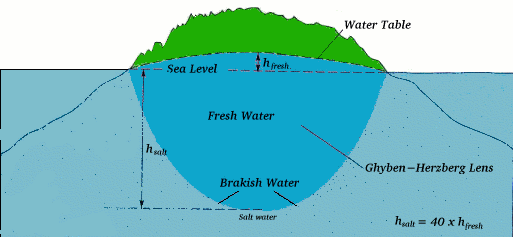
They reported about the East Frisian Islands and the drinking water lens below most of these island and about the only offshore island Helgoland (North Sea) where people get their water after desalination of sea water. The island Sylt represented the North Frisian islands. And they report about the island Usedom in the Baltic Sea, which is close to the Polish border.


They told her about some basic items like size, shape and population of the islands. The slides contain pictures with wonderful views about these islands as well as some pictures which gave hints to the drinking water supply.


A very important fact concerning the water supply was the number of tourists which visits the islands every year. These tourists are in number twice as many - or more - as the regular number of inhabitants. Tourism has a great impact on the water consumption to any of these islands.


They enlightened the history of some of these islands concerning the development of the drinking water supply technology and its tube network.


Comparing Climate diagrams from some islands and our home town the students pointed out the importance of rainfall to fill the natural reservoires below the surface.

Referring to some layers of the earth and to the geological history of the islands the students reported about the ingredients of the local drinking water.


After the students' presentation Anne told them about the drinking water situation in her area and how her family and all the animals living there get their drinking water.

The meeting took about 80 minutes time where my students learned a lot from Australia as well. Thank you, Anne, for being our guest during this chemistry lesson.

Thursday, April 10, 2014

How do people on a German island get their drinking water?

This is one of the main problems students of grade 7 (three classes) have to face in their chemistry lessons at the moment. After checking the water supply of their hometown Sundern, they had to choose an island from Germany and find out how people of this island get their drinking water. First time ever they have prepared a digital presentation. First time ever they have prepared an English presentation they present to teachers and classes from abroad.

Each class has been split up into small groups of 2- 4 students. Each group has to prepare a research about one island. They present some pictures and information about the island and express technical, economical and geophysical aspects which impact the drinking water supply. Some island are built on sand, others are built on rocks and again others are built from farmland and they were seperated from the mainland throughout flooding.


Islands from the North Sea like Helgoland, Sylt, Föhr, Hallig Hooge and Pellworm, Langeoog, Juist, Rügen and Fehmarn from the Baltis Sea and many others were presented by wonderful pictures. They described the fresh water lens which is located below a number of the Fresian islands and how people on the island named Helgoland get their desalinisated water by reverse osmosis.


Difficulties has been faced because some companies do not offer any information about drinking water supply in the internet generally. So they called them by phone to get further information.

The students present the results of their research after they did a 5 minutes' skype meeting before with several teachers and classes to invite them joining their presentation.


(students are presenting the island of Juist)

Wednesday, October 9, 2013

Oceans and Climate


I am a science teacher and I thought that I had already known a lot about the connection between oceans and climate. Until this morning, because we had an expert meeting with my 8th graders. Using Skype in the classroom we had a phantastic meeting with Joanne Kerr, paleo- oceanographer at the University of Cambridge, England.


It was very early in the morning, at 7 am UK time, when we met her with a small group of students who are educated in chemistry about climate change and global warming. Teaching this topic you automatically come across the connection between the oceans and climate and how both affect each other.

The students prepared several questions about what they have discussed before in their lessons. They got answers about the ocean circulation, salt concentration and temperature and how that all depend on each other. And they got important information how global warming will impact the oceans and how oceans themselves will impact life on earth when the earth will go on heating up constantly.
The students added some further questions concerning her personality and the profession to become an oceanographer.


Jo herself had prepared a ppt in advance about her work and about the places where she is usally researching which she presented at the beginning.


The whole meeting took about 1 hour time and we, students and me, learned a lot and new things concerning the connection between oceans and climate.

Hope to see you soon.
Thank you very much, Jo Kerr!!!


This is a short cut of the video. The complete video can be watched here.

~~~~~~~~~~~~~~~~~~~~~~~~~~~~
Thanks a lot to all supporters including " Skype in Education" and "Digital Explorer".
Related resources, lesson plans and multimedia materials are available for download from: http://oceans.digitalexplorer.com/resources/?controller=search

Sunday, April 21, 2013

Café Dilemma


"CAFÉ DILEMMA": What do students, grade 10, think about  "same sex marriage"?


A small group of students from grade 10 at our school discussed the "for" and "against" of this controverse topic with their moderator, Mr Steve Sherman, from Cape Town, South Africa. Using Skype facilities in my classroom they met him straight in a café in Cape Town, where he offered them "... some food to think about" (Steve Sherman).


(Mr Steve Sherman sitting for lunch in a Café in Cape Town, S.A., moderator of the discussion group)

After exchanging some statements for and against same sex marriage they pointed out how cultural diversities and media influence their argumentation.

At a "CAFÉ DILEMMA" students from different nationalities and cultural backgrounds meet to argue for and against a specific statement usually.

The German students asked for this meeting the first time. They met far from their usuall time table during their lunch break.
Both parties finally concluded to repeat this meeting again in the near future.

Thank you, Mr Sherman, for your support!!!


Wednesday, March 13, 2013

Lunchboxes Around The World

As parents we always keep an eye on what our children eat for lunch at school. Either we check their lunchboxes at home before they will leave for school or we hopefully know what they will eat for lunch at the school's cantine. Whatever we - as parents - accept for lunch it depends on what we can offer to them. And we decide what is healthy food and what they should avoid to eat. For children it is useful sometimes to get aware of what other children in other part of the world get for lunch (if they get anything for lunch at all!) to value their own food.

Students at lunch in Staint Lucia, West Indies


Teachers from schools from the West Indies, from Africa, Japan and Australia took pictures of their students' lunchboxes and from their cantines to show these to my students. And Anne Mirtschin from Hawkesdale College, Victoria, Australia, presented her slideshow this morning straight using Skype and Elluminate Blackboard services. My students compared these meals with the food they usually eat and decided what they would like to eat and which food might be a healthy food for them.


A typical lunchbox in Australia

My students were watching the presentations by Anne Mirtschin from Australia,
who was so kind to report on her pictures by herself.
Thank you Celina Fessall from St. Lucia, Simon Lorimer from Yokohama International School, Anne Mirtschin from Australia and  Peter Jackson from Lusaka, Sambia, for their nice pictures. My students learned a lot.